Showing posts with label wildflowers. Show all posts

Sunday, July 26, 2009

Some Favorites

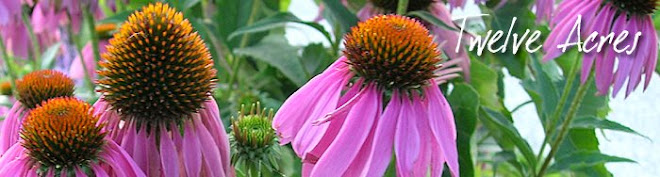
My favorite native American wildflower is the purple coneflower. They are so beautiful and so easy to grow, no garden should be without at least one clump of them. I always grow mine from seed and have never had to buy a single plant. They do really well in Ohio clay and just glow despite the heat and sun of late summer.

I only grow the species, Echinacea purpurea, and none of the frou-frou hybrids. Anyone who knows me knows I wouldn't be caught dead with hybrids in my garden. Yes, I'm a plant snob.

This little spot of wildflowers follows the curve of the driveway. A white birch is to the left and is already 8 feet tall after only 2 years! This little bird house was our first project when we moved in three years ago. I love it. Tree swallows successfully raised their young in it this spring and it is currently inhabited by a large group of paper wasps, which are welcome in my garden because they are one of nature's best organic pesticides! I often weed within one foot of the bird house and they never bother me. I've even supported myself by grabbing the wooden post but they seem to know that I mean them no harm and they ignore me. I often find myself extolling the virtues of wasps as a gardener's friends to those who fear them. Mud daubers are equally good at killing insects, although they specialize in killing only spiders which they place in the cells of their nests for their larvae to feed on. Gruesome, but true!

Tuesday, March 10, 2009

Chickweed and Lamb's Quarter

Last spring I wrote about chickweed and how much my chooks loved it. At the time, they were too small to let them out to forage on their own, so I picked bucketsful of chickweed each day and put it in their run for them. They devoured it with gusto.

Spring is almost here as evidenced by the return of the turkey vultures and song sparrows last week. Today the chickens were chasing and catching small flies that looked like large gnats, the first insects of the season. Some plants are beginning to come to life too, like chickweed. The chickens stormed the field on our property and feasted on the fresh, green patches of chickweed. While it is edible, I've never tried it. The plant is rich in vitamin C and it helps the chickens make some very tasty eggs with deep golden yolks. For a very informative website about chickweed,
click here.

There is a spring weed that I do gather and cook though: lamb's quarter. I learned about its culinary possibilities last year and I can hardly wait for it to reappear! It tastes exactly like spinach and you've never tasted lamb's quarter, you really should give it a try. I've added it to spinach salads and I've sauteed it in butter. It's absolutely delicious and it has nutritional value as well. It grows everywhere around our property and I really like its price--FREE!

With spring just around the corner and lots of uncultivated areas on our property, I'm looking forward to the return of the edible wild plantsthat grow here, for both man and beast.


Monday, January 7, 2008

The Fence Row

The fence row is a wooded area that borders the south edge of the twelve acres. Although I've never measured it (but now I must!) I would estimate its length to be well over 400 feet. It has three narrow drainage ditches running the length of it and is covered with mature hardwood trees. The tree roots hold the mounded earth in between the ditches firmly in place. They do such a good job at retaining the soil that little has changed in its height or width since my childhood--truly a testament to the value of tree roots in the prevention of soil erosion. These trees were just seedlings when this area was claimed by my great-grandfather, Harold G. Moore. He turned what was once part of the Great Black Swamp into sugar beet fields, then later along with his sons, he planted the fruit trees that would become Moore Orchards. What was once uninhabitable swampland is now acres of apple, peach, pear and plum trees. Our property lines are clearly visible because of these large fence rows that were left standing to act as natural property boundaries. Apple trees grow on the other side of our fence row.

I took this photo on a late summer evening in 2007 just as the sun went down. The crescent moon looked lovely. I love the silhouettes of the trees in the fence row. That night we were treated to getting to listen to the pair of Great Horned Owls as they spent at least 15 minutes calling to each other, "Hoo, hoo-hoooo, hoo, hoo-hoo!" One owl's voice was higher than the others' and my bird book said that the female's voice was the higher one. How interesting!

Starting at the east end, I plan to naturalize this fence row. It has been a dream of mine since I was little. Wouldn't it be lovely to walk through this area and see all kinds of wildflowers with butterflies and birds enjoying the blooms? In my previous post I listed the perennial species I plan to sow this spring. I think they will have an easy time of getting established. They'll have dappled sunlight from the sparse trees at the east end and the soil is ideal for plant growth. I certainly hope they do well at least!

Over the years, as trees have matured and the canopy has gradually risen, what was once a solid stand of trees has become sparse with large visible gaps between the trees. As a result I feel like I have less privacy from my cousin's farm at the end of the road. It is my goal to fill in the gaps with new trees. This spring, I am going to plant young trees inside the fence row to replace the trees that have either died naturally or been removed by us. The trees we've cut have been strategically removed to allow more light to penetrate the canopy, which in turn will give new plantings better light and less competition for soil nutrients. I plan to plant a mixture of deciduous and coniferous trees including some stately Dawn Redwoods and Bald Cypress, which are fast growing deciduous conifers. Some Red Maples will go in because of their quick growth and some Forsythias will make for a colorful understory planting. While deciduous trees can provide a visual screen only when they have leaves, conifers can provide privacy (and windbreak benefits) year-round.

What's growing in the fence row right now? A large variety of native Ohio trees and understory shrubs. I walked through it last fall and collected the leaves and fruits (if found) of the trees and shrubs. There are plenty of Red Osier Dogwoods for understory growth as well as a few shorter trees, including one native crab apple tree. There are several American Elms, White and Green Ashes, Shagbark Hickories, Pin Oaks, Hackberry, Hawthorns, Mulberry, a gargantuan White Poplar and several large trees I haven't been able to identify yet. We have been working throughout fall and winter to eliminate the wild grape vines and poison ivy growing up the trees and have been able to remove a lot of it.

There are quite a few snags standing in the fence row that I adamantly refuse to remove because there are nest cavities in them. Screech Owls and Northern Flickers use the larger cavities which are excavated by our native woodpeckers. I have also been moving dead and rotten logs away from the foot path and leaving them on the sides. The decaying logs provide food and habitat for a myriad of fungi and insects. There is one very large snag with a cavity nest in it that has been designated as the screech owl area. I have placed dead logs around the base of the snag to allow smaller wildlife to use them as cover which in turn feeds the owls.

As we manage the fence row we are keeping our eye on the future. This special area is a connecting point between nature and us. I want to be able to walk through the fence row without tripping over logs or getting my eyes poked out by twigs, but I don't want it to be so manicured that it looks like a park and the birds are reluctant to nest in it. Finding the balance between the two worlds is not as challenging as one might think. It simply takes some common sense and research, as well as educating the next generation on effective land management so that our efforts will not go to waste when we are gone.

Seed Purchase

It has been a dream of mine for years and now I'm going to finally make it happen--I'm going to naturalize the east end of the fence row! And I'm going to do it all by scattering and sowing seed.

Yesterday I ordered:
  • 4,500 Apricot Foxglove seeds
  • 50,000 'Excelsior' Foxglove seeds (above)
  • 600 Echinacea purpurea seeds
  • 100 'Band of Nobles' mixed Lupine seeds (below)
I will wait till very early spring on a day before rain is predicted and I will go sow my little heart out. The Foxglove seeds will get mixed together and scattered widely amongst the tree trunks. I will hand plant the Lupines and Purple Coneflowers.
The Purple Coneflower is my favorite native American wildflower. I must have them wherever I am. I grew them from seed in Fremont and I will do the same here. I have so many garden plans in my head it's all I can do to keep my head from swimming! But this is the joy of gardening!

I also love Lupines but they aren't fond of Ohio clay. Fortunately for me (and them) the fence row's soil is rich with organic matter from centuries of leaf fall. The Lupines will have the soil they prefer which is a well-drained loam, rich and black with organic content!

Of course, there will be many other perennials introduced to the fence row, but all in good time. If I plant it all now what will I do for the next 30 or so years?