Showing posts with label black swamp. Show all posts

Sunday, January 13, 2008

The Twelve Acres From Above

Thanks to Google Earth I can take a look at the twelve acres from a satellite's perspective. Imagine what it looks like to the raptors! I don't know how old this photo is but I can tell that it was taken after the tornado went through and removed the northern end of the windbreak on June 25, 1996 (top of photo is north). The photo was taken before the Rose of Sharon's were removed from the back yard and before we cut down the old, rotten poplar tree that used to shade the master bedroom. A baby River Birch has since replaced it.

The south end of the twelve acres is bordered by the fence row. The thinner end on the right is my wildlife garden area which will be planted this spring. The ash trees we've thinned from the fence row were used for firewood. I'm going to be planting a lot of new trees in the fence row to try to increase the variety of hardwood and softwood species.

The pond is a hideous fake blue, the result of my ex-step-dad putting blue dye in it (how incredibly stupid). It will be some time before that ugly blue returns to a natural color like the neighbor's wildlife pond on the other side of the woods (second photo).

This photo shows the entire family plot. All those little evenly space green dots are the fruit trees my grandpa, great uncle and now cousin-twice-removed have planted. There are several orchards around the family property. They produce all the apples, peaches, pears and plums that get sold in the family-run store, Moore Orchards. There are several orchards in the Great Black Swamp area because the soil here is ideal for agriculture. Fruit trees do well in this soil. It's the soil the Wisconsin glacier left behind during the last glacial period.
We are 574 feet above sea level here but about a foot below Lake Erie level. Without the complex system of drainage ditches, dikes and pumps that drain into the Toussaint River (bottom of photo) we would have knee deep water in our front yard! My cousin John keeps us dry year-round by running the family pump, seen at the bottom right corner of the photo.
I look at the open canvas that is the twelve acres and my thoughts immediately turn to the trees I'm going to plant all around it over the next few years. I wonder how these pictures will differ in a decade? There will certainly be less open gaps in our windbreak and the yard will have a two-tiered windbreak filling in in the back yard to break the strong southern winds we get out here. The pond should be slate blue again and there will be many more green dots throughout the yard.
When we first moved here I was overwhelmed by the amount of trees that need to be replaced. However, now that I have it planned and know what I'm doing it's actually a very enjoyable pastime. Hurry up spring! I'm anxious to get started!

Monday, January 7, 2008

The Fence Row

The fence row is a wooded area that borders the south edge of the twelve acres. Although I've never measured it (but now I must!) I would estimate its length to be well over 400 feet. It has three narrow drainage ditches running the length of it and is covered with mature hardwood trees. The tree roots hold the mounded earth in between the ditches firmly in place. They do such a good job at retaining the soil that little has changed in its height or width since my childhood--truly a testament to the value of tree roots in the prevention of soil erosion. These trees were just seedlings when this area was claimed by my great-grandfather, Harold G. Moore. He turned what was once part of the Great Black Swamp into sugar beet fields, then later along with his sons, he planted the fruit trees that would become Moore Orchards. What was once uninhabitable swampland is now acres of apple, peach, pear and plum trees. Our property lines are clearly visible because of these large fence rows that were left standing to act as natural property boundaries. Apple trees grow on the other side of our fence row.

I took this photo on a late summer evening in 2007 just as the sun went down. The crescent moon looked lovely. I love the silhouettes of the trees in the fence row. That night we were treated to getting to listen to the pair of Great Horned Owls as they spent at least 15 minutes calling to each other, "Hoo, hoo-hoooo, hoo, hoo-hoo!" One owl's voice was higher than the others' and my bird book said that the female's voice was the higher one. How interesting!

Starting at the east end, I plan to naturalize this fence row. It has been a dream of mine since I was little. Wouldn't it be lovely to walk through this area and see all kinds of wildflowers with butterflies and birds enjoying the blooms? In my previous post I listed the perennial species I plan to sow this spring. I think they will have an easy time of getting established. They'll have dappled sunlight from the sparse trees at the east end and the soil is ideal for plant growth. I certainly hope they do well at least!

Over the years, as trees have matured and the canopy has gradually risen, what was once a solid stand of trees has become sparse with large visible gaps between the trees. As a result I feel like I have less privacy from my cousin's farm at the end of the road. It is my goal to fill in the gaps with new trees. This spring, I am going to plant young trees inside the fence row to replace the trees that have either died naturally or been removed by us. The trees we've cut have been strategically removed to allow more light to penetrate the canopy, which in turn will give new plantings better light and less competition for soil nutrients. I plan to plant a mixture of deciduous and coniferous trees including some stately Dawn Redwoods and Bald Cypress, which are fast growing deciduous conifers. Some Red Maples will go in because of their quick growth and some Forsythias will make for a colorful understory planting. While deciduous trees can provide a visual screen only when they have leaves, conifers can provide privacy (and windbreak benefits) year-round.

What's growing in the fence row right now? A large variety of native Ohio trees and understory shrubs. I walked through it last fall and collected the leaves and fruits (if found) of the trees and shrubs. There are plenty of Red Osier Dogwoods for understory growth as well as a few shorter trees, including one native crab apple tree. There are several American Elms, White and Green Ashes, Shagbark Hickories, Pin Oaks, Hackberry, Hawthorns, Mulberry, a gargantuan White Poplar and several large trees I haven't been able to identify yet. We have been working throughout fall and winter to eliminate the wild grape vines and poison ivy growing up the trees and have been able to remove a lot of it.

There are quite a few snags standing in the fence row that I adamantly refuse to remove because there are nest cavities in them. Screech Owls and Northern Flickers use the larger cavities which are excavated by our native woodpeckers. I have also been moving dead and rotten logs away from the foot path and leaving them on the sides. The decaying logs provide food and habitat for a myriad of fungi and insects. There is one very large snag with a cavity nest in it that has been designated as the screech owl area. I have placed dead logs around the base of the snag to allow smaller wildlife to use them as cover which in turn feeds the owls.

As we manage the fence row we are keeping our eye on the future. This special area is a connecting point between nature and us. I want to be able to walk through the fence row without tripping over logs or getting my eyes poked out by twigs, but I don't want it to be so manicured that it looks like a park and the birds are reluctant to nest in it. Finding the balance between the two worlds is not as challenging as one might think. It simply takes some common sense and research, as well as educating the next generation on effective land management so that our efforts will not go to waste when we are gone.

Wednesday, January 2, 2008

Bald Cypress

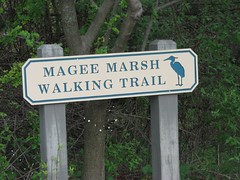
Derek and I went to Black Swamp Bird Observatory at Magee Marsh today. It's only about 5 miles from our house and I'd been wanting to go out there to see the marsh area again. It was too cold to walk the bird trail but we got to see 5 white tail deer, a gaggle of Canada geese and Derek saw a Cooper's hawk which I missed.

What struck me more than the fauna was the flora. There are some outstanding oaks throughout the marsh. And then there's the row of Bald Cypress trees growing in the stream next to the observation deck at the head of the bird trail. I noticed their uniform branching and deeply furrowed trunks. For such a tough tree they have a very fine texture.
I have been considering planting some Bald Cypress in our windbreak and now that I've seen their beautiful, red trunks and lovely pyramidal shape, I have made up my mind that I must plant some. Who could turn down such nice looking trees? The bonus is they can handle all sorts of soil conditions from dry to knee-deep water. Perfect for our windbreak!

I think the one negative aspect of Bald Cypress trees is they are deciduous. That means little to no windbreak protection in the winter, something that makes spruces and Arborvitaes preferred plantings for windbreak areas. I think deciduous conifers are oddballs, but I grew up with evergreens and I'm not used to seeing a conifer drop its needles completely. Still, I'd like to have some beautiful Bald Cypress trees like the ones I saw today. Come next spring when the soil and water conservation district offers tree seedlings for sale, I'll be sure to order some Bald Cypress babies for the windbreak.

Monday, December 31, 2007

Waiting For The Storm


It's New Year's Eve and we are expecting a snow storm tonight. A winter weather advisory was issued early in the day today but I haven't seen a single snowflake yet at 10:30 p.m. We are predicted to get 3" - 6" of snow by tomorrow morning. We'll see. Snow storms just aren't what they used to be. Heck, when I was a kid we'd still go to school if there was only 3" of snow on the ground. They cancel school for that much now.

As the crow flies we are less than 10 miles from the south shore of Lake Erie. We live in a protected pocket here which means the weather predictions for our area are more often than not, incorrect. In fact, we are even in a different USDA zone than the folks just a few miles south of us! Most of northern Ohio is in zone 5a but we are in zone 6a. That means I can plant a larger variety of perennials in my yard.

If we get some snow I'll be outside with my camera tomorrow. Hopefully we'll get some pretty scenery on the property!